
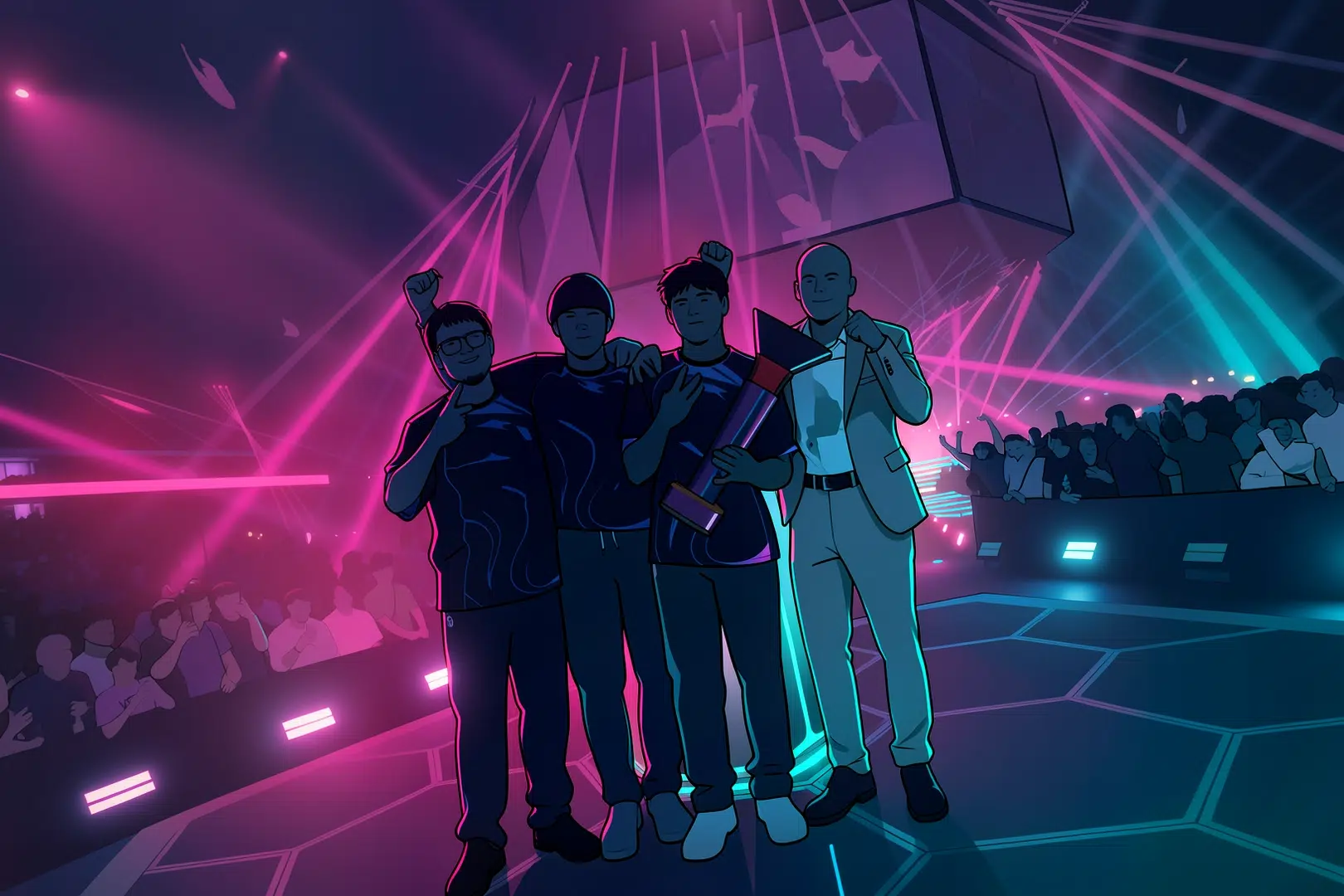
The numbers from the RLCS 2026 World Championship Play-In are, on their face, encouraging. The opening phase averaged almost 31% more viewers than the same stage last year. Peak Viewers reached 173.2K, a jump of over 40.5%. Hours Watched rose 46.5% to just over 782K, despite the broadcast running only 35 more minutes than the 2025 edition.
Growth across every major metric. That is the headline.
The driver is not mysterious. Team Falcons, the 2025 World Championship runner-up, arrived at the Play-In after barely qualifying through the Middle East and North Africa Points Ranking. Their two matches were the only ones to surpass 150K Peak Viewers. The Saudi organization won both and advanced to the Group Stage.
One team, two matches, and the entire phase tilts upward. Spanish-language broadcasts overtook French as the second-most-watched language by watch time, lifted by Mate y Tapa’s run before elimination. TikTok grew sharply, with the official English channel recording year-on-year watch time growth of more than 1397%.
The Play-In worked because a story worked. That is not the same as structural health.
A Season of Two Extremes
To read the Play-In in isolation is to misread it.
Earlier this year, the RLCS 2026 Boston Major set an all-time franchise record: 624,000 Peak Viewers, the first time Rocket League esports crossed the half-million mark. The event averaged 270K viewers across nearly 28 hours and accumulated 7.55 million Hours Watched, third all-time in RLCS history, behind only two World Championships that ran more than twice as long.
That was February.
By May, the Paris Major arrived and the numbers collapsed. The most-watched match of the tournament, Team Vitality versus Karmine Corp, peaked at approximately 179,000 concurrent viewers. Boston’s opening day alone generated over 1.6 million Hours Watched; Paris hovered around 800,000 across its opening day.
The gap is not explained by Rocket League losing its audience. It is explained by the absence of the audience aggregator. Nicholas “Jynxzi” Stewart, whose co-streaming during Boston drew millions across Twitch and YouTube, was not present in Paris. When he vanished, the numbers vanished with him.
The French and Arabic broadcasts that powered Boston’s record were not enough to compensate. The competitive storylines existed. The distribution architecture did not.
The Platform Shift Hiding in Plain Sight
The Play-In data confirms something the broader esports ecosystem is already confronting. Twitch remained the leading platform by watch time for the Play-In. But TikTok’s growth, and the broader migration toward Kick, signals a redistribution that platforms and sponsors are still learning to price.
Kick’s role in the 2026 Esports World Cup was decisive: the platform saw its EWC Hours Watched double year-over-year, and EWC viewership overall jumped 37%, with average live viewership rising 36.9%. The audiences are not disappearing. They are moving to places where measurement is less centralized, where co-streamers operate outside official broadcast structures, and where the line between tournament viewership and creator viewership has already dissolved.

What the Play-In Growth Actually Measures
The 31% Play-In increase is real. It is also dependent on a specific team’s presence, a specific regional narrative, and a specific competitive circumstance, Falcons having to qualify through the Play-In rather than entering directly.
Remove that variable, and the structural picture is less comfortable. Boston showed what Rocket League esports can achieve when a co-streaming ecosystem, regional language broadcasts, and a compelling final converge. Paris showed how quickly that achievement can be reversed when one pillar is removed.
The Play-In numbers are not proof of growth. They are evidence that the ecosystem’s floor and ceiling are both lower and higher than the official broadcast suggests, and that the distance between them is not controlled by the league. It is controlled by who shows up to stream, who shows up to watch, and on which platform they decide to do it.

 Lex Northbyte